PARADISE by Abdulrazak Gurnah

PARADISE by Abdulrazak Gurnah

PARADISE by Abdulrazak Gurnah

For Salma Abdalla Basalama

"Yusuf had heard the boys say that the Germans hanged people if they did not work hard enough. If they were too young to hang, they cut their stones off." page 7


" They made up names for the places their parents came from, funny and unpleasant names which they used to abuse and mock each other. Sometimes they fought, tumbling and kicking and causing each other pain. If they could, the older boys found work as servants or errand runners, but mostly they lounged and scavenged, waiting to grow strong enough for the work of men. Yusuf sat with them when they let him, listening to their conversation and running errands for them." page 7


He was already twelve. To his amazement she did not let him go this time. Usually She released him as soon as his struggles became furious smacking his fleeing bottom as he ran. Now she held him, squeezing him to her steeping softness, saying nothing and not laughing. The back of her bodice was still wet with sweat, and her body reeked of smoke and exhaustion. He stopped struggling after a moment and let his mother hold him to her. Page 13


You'll come and trade with us, and learn the difference between the ways of civilization and the ways of the savage. It's time you grew up and saw that the world is like ... Instead of playing in dirty shops. A smile geew on his face as he spoke, a predatory grimace which made Yusuf think of the dogs that prowled the lanes of his nightmares. page 52


" When I think of truth, I see your face,
And every other face is nothing but a lie.
when I dream of happiness, I feel your caress.
And I see envy burning in everyone eye." page 54


"Everwhere they went now they found the Europeans had got there before them, and had installed soldiers and officials telling the people that they had come to save them from their enemies who only sought to make slaves of them. It was as if no other trade had been heard of, to hear them speak. The traders spoke of the Europeans with amazement, awed by their ferocity and ruthlessness. They take the best land without paying a bead, force the people to work for them by one trick or another, eat anything and everything however tough or putrid. Their appetite has no limit or decency, like a plague of locusts. Taxes for this, taxes for that, otherwise prison for the offender, or the lash, or even hanging. The first thing they build is a lock-up, then a church, then a market-shed so they can keep the trade under their eyes and then tax it. And that is even before they build a house for themselves to live in." page 72


"Where is this garden? Kalasinga asked. 'In India? have seen many garden with waterfalls in India.Is this your paradise?Is this where the Aga Khan lives?" page 80


"The east and the north are known to us, as far as the land of China in the farthest east and to the ramparts of Gog and Magog in the north. But the west is the land of darkness, the land of jinns and monsters. God sent the other Yusuf as a prophet to the land of jinns and savages.Perhaps he'll send you to them too." page 83


"Each day the land changed on them as they descended from the high mountain ground. The settlements grew less clustered as the country dried out. Within days they were down on the plateau and their column raised clouds of dust and grit with every step. The scattered scrub took formidably gnarled and twisted forms, as if existence was a torture. The songs and spirits of the porters also dried up as they contemplated the unkind country they were entering. They came to life when they saw huge herds of animals in the distance, arguing bitterly among themselves as they debated their identities. In those first days, Yusuf's stomach turned to water and his body ached with exhaustion and fever. Thorns tore into his ankles and arms, and his flesh was covered with insect bites." page 116


"Yusuf could not bear to look on the incredible horror of the wounds, swollen now with disease. He wanted life to end at the sight of such a pain. He had never seen or imagined anything like it. They found bodies everywhere, in the burnt- out huts, near the bushes, under the trees." page 127

"look at their happiness, he said, unsmiling. "Like a mindless herd of beasts approaching water. we're all lik that, small-minded creatures misled by our ignorance. What is their excitement for? Do you know?" page 129- 130


"Never trust the Indian!" Mohammed Abdalla said angrily. " He will sell you his own mother if there's profit in it. His desire for money knows no limits. When you see him, he looks craven and feeble, but he will go anywhere and go anything for money.
Uncle Aziz shook his head at the mnyapara, admonishing him for his impetuosity. 'The Indian knows how to deal with the European. We have no choice but to work with him." page 133


"Then one day that devil Muhammad Abdullah come and took me and my sister away, and brought us here. we were to be rehani until our Ba could replay his dept. He died very soon after that, my poor Ba, and Ma and my brothers went back to Arabia and left us here. They just left us here." page 203


" Get on with it " Mzee Hamdani says always.


" I know the freedom you are talking about. I had that freedom the moment I was born. When these people say you belong to me, I own you, it is like the passing of the rain, or the setting of the sun at the end of the day. The following morning the sun will rise again whether they like it or not. The same with freedom. They can lock you up, put you in chains, abuse all your small longings, but freedom is not something they can take away. When they have finished with you, they are still as far away form owning you as they were on the day you were born." page 224. ( It means real freedom is inside a person — no one can truly take it away, even if they imprison or control you.)


"When she was seven years old, my poor stupid Ba, may God have mercy on him, offered her to the seyyid as part of the payment. And I was to be rehani to him until she was of an age to be married, unless my Ba could redeem me before then. But he died, and my Ma and my brothers went back to Arabia and left me here with our shame. When that devil Mohammed Abdalla came to collect us, he made her undress and stroked her with his filthy hands." page 231

" He would say to her: If this is Hell, then leave. And let me come with you. They've raised us to be timid and obedient, to honour them even they misuse us. Leave and let me come with you. We're both in t middle of nowhere. Where else can be worse? There would be no wall garden there, wherever we go, with sturdy cypresses and restless bush and fruit trees and unexpectedly bright flowers. Nor the bitter scent orange sap in the day and the deep embrace of jasmine fragrance night, nor fragrance of pomegranate seeds or the sweet herbaceous grasses in the borders. Nor the music of the water in the pool and the channels. Nor the contentment of the date grove at the cruel height of the day. There would be no music to ravish the senses. It would be like banishment, but how could it be worse than this?" page 233-34


" I did her not wrong. I sat with her because she invited me in. My shirt was torn from behind, Yusuf said, his voice shaking in an unexpected and annoying way. 'That show. I\Was running away.'" page 239

r

The Wild Iris, Louise Glück

THE WILD IRIS by Louise Glück

(The Wild Iris, Louise Glück)

Notes from book:

"THE WILD IRIS

At the end of my suffering

there was a door.

Hear me out: that which you call death

I remember.

Overhead, noises, branches of the pine shifting.

Then nothing. The weak sun

flickered over the dry surface.

It is terrible to survive

as consciousness

buried in the dark earth.

Then it was over: that which you fear, being

a soul and unable

to speak, ending abruptly, the stiff earth bending a little. And what I took to be birds darting in low shrubs.

You who do not remember

passage from the other world

I tell you I could speak again: whatever returns from oblivion returns

to find a voice:

from the center of my life came

a great fountain, deep blue

shadows on azure seawater." Page 1


"Who else would so envy the bond we had then as to tell us it was not earth

but heaven we were losing?" page 44

"EARLY DARKNESS

How can you say

carth should give me joy? Each thing

born is my burden; I cannot succeed

with all of you.

And you would like to dictate to me,

you would like to tell me

who among you is most valuable,

who most resembles me.

And you hold up as an example

the pure life, the detachment

you struggle to achieve-

How can you understand me

when you cannot understand yourselves?

Your memory is not

powerful enough, it will not

reach back far enough-

Never forget you are my children.

You are not suffering because you touched each other

but because you were born,

because you required life

separate from me. " page 45

"the first rains of autumn shaking the white lilies-

When you go, you go absolutely, deducting visible life from all things

but not all life,

lest we turn from you. "page 55

"SEPTEMBER TWILIGHT

I gathered you together,

I can dispense with you-

I'm tired of you, chaos

of the living world-

I can only extend myself

for so long to a living thing.

I summoned you into existence

by opening my mouth, by lifting

my little finger, shimmering

blues of the wild

aster, blossom

of the lily, immense,

gold-veined-

you come and go; eventually

I forget your names.

You come and go, every one of you

flawed in some way,

in some way compromised: you are worth

one life, no more than that.

I gathered you together;

I can erase you

as though you were a draft to be thrown away,

an exercise

because I've finished you, vision

of deepest mourning." page 60

e

A Sorrow Beyond Dreams by Peter Handke

A Sorrow Beyond Dreams by Peter Handke

Translated from the German by Ralph Manheim

Notes from book:

"He not busy being born is busy dying." Bob Dylan

"Dusk was falling quickly. It is was just after 7 p.m., and the month was October."

- patricia Highsmith, A Dog's Ransom

"I am writing this story of my mother, first of all because I think I know more about her and how she came to her death then any outside investigator who might, with the help of religious, psychological, or sociological guide to the interpretatin of dreams, arrive at a facile explanation of this interesting case of suicide; but second in my own interest, because having something to do brings me back to life; and lastly because, like an outside investigator, though in a different way, I would like to represent this VOLUNTARY DEATH as an exemplary case." page 5

"This may in his time have been true for my grandfather, the first in a long line of peasants fettered by poverty to own anything at all, let alone a house and a piece of land." page 8

"The fortune teller at our church fairs took a serious interest only in the palms of the young men; a girl's future was a joke." page 10

"And what was "politics"? A meaningless word, because, from your schoolbooks on, everything connected with politics had been dished out in catchwords unrelated to any tan-gible reality and even such images as were used were devoid of human content: oppression as chains or boot heel, freedom as mountaintop, the economic system as a reassuringly smoking factory chimney or as a pipe enjoyed after the day's work, the social system as a descending ladder:"Emperor-King-Nobleman-Bur-gher-Peasant-Weaver-Carpenter-Beggar-Gravedigger"; a game, incidentally, that could be played properly only in the prolific families of peasants, carpenters, and weavers." page 15

"She wasn't lonely; at most, she sensed that she was only a falf. But there was no one to supply the other half. "We rounded each other out so well," she said, thinking back on her days with the savings-bank clerk; that was her idea of eternal love." page 24

"The word "poverty" was a fine, Somehow noble word. ) It evoked an image out of old Schoolbooks: poor but clean. Cleanliness made the poor socially acceptable. Social progress meant teaching people to be clean; once the indigent had been cleaned up, " poverty" became a title of honor. Even in the eyes of the poor, the squalor of destitution applied only to the filthy riffraff of foreign countries." Page 38

"To ber, every book was an account of her own afe, and in reading she came to life, for the first time, the ame out of her shell, the learned to talk about herself; md with each book she had more ideas on the subject ittle by little, I learned something about her." page 44

"Politicians live in another world. When you asked them a question, they didn't answer; they merely stated their position. "You can't talk about most things anyway." Politics was concerned only with the things that could be talking about; you had to handle the rest of yourself, or leave it to God. And besides, if a politician were to take an interest in your personally, you'd bolt. That would be getting too intimidate." page 48

"I can't stand it in the house anymore, so I'm always gadding about somewhere. I've been getting up the little earlier, that's the hardest time for me; I have to force myself to do something, or I'd just go back to bad. There's a terrible loneliness inside me, I don't feel like talking to anyone." page 58

"All the Jukeboxes in the region had a record titled WORLD-WEARY POLKA" page 69

"Horror is something perfectly natural: the mind's horror vacui. A thought is taking shape, then suddenly it notices that there is nothing more to think. Whereupon it crashes to the ground like a figure in a comic strip who suddenly realizes that he has been walking on air.

Someday I shall write about all this in greater detail." page 70

FLIGHTS, by OLGA TOKARCZUK

FLIGHTS, by OLGA TOKARCZUK

FLIGHTS

by OLGA TOKARCZUK

Translated by Jennifer Croft

Notes from book:

"In spite of all the risks involved-a thing in motion will always be better then a thing at rest; that change will always be a nobler thing than permanence; that that which is static will degenerate and decay, turn to ash, while that which is in motion is able to last for all eternity." page 4

a true nomad. Page 6

"Immigrants still en route to that fair, idyllic country They were sure was somewhere in the west. where People are brother and sister, and a strong state plays the role of parents; figitives from their families - from their wives, their husband, their parents; the unhappily in love, the confused, the melancholic, those who were always cold." page 9

“... whenever I managed to save any money, I would be on my way again.” Page 10

"- all the little tricks we let ourselves perform - if instead we simply saw the world as it was, with nothing to protect us, honesty and courageously, it would break our hearts." page 12

“The only extravagance able to be afforded went to blood: blood is a warning, its redness an alarm that the casing of the body has been breached. That the continuity of the tissue has been broken. In reality, on the inside we have no color. When the heart pumps out blood as it's supposed to, blood looks just like snot.” page 22

"I feel as though these trains were just invented for people with a fear of flying.” page 61

"Escaping their own lives, and then being safely escorted right back to them." page 62

"They say that you have to sacrifice some living being when you build an airport she replied to ward off catastrophe." page 64

"But don't let yourself be taken in by the diversity. It's superficial," she said. "it's all smoke and mirrors. In reality, everywhere is the same. In terms of animals. In terms of how we interact with animals." page 66

"That man, wherever he may be born, so long as he be good, and wise, having wisdom in his soul, even diverging from us in form, color, voice, bearing, has inevitably descended from the first human forehead, Adam, and is thus capax for salvation." page 72

"Life is made up of situations." page 77

"You just have to show up, sign in at that one single configuration of time and place. There you will find your great love, happiness, a winning lottery ticket or the revelation of the mystery everyone's been killing themselves over in vain for all these years, or death. Sometimes in the morning one even has the impression that this moment is close by, that today might be the day it will arrive ." page 79


"Life aboard a ship is immersion not in Salt water, not in the rains over the northern seas, nor even in sunshine, but rather in adrenaline. There is no timetothink, no meditation over spilled milk." Page 84

"Because it must be noted that Chinese people have two names: one given by their families, used to summon the child, scold and punish him, but also the basis for affectionate nicknames. But when the child goes out into the world, he or she takes another name, an outside name, a world name, a personage name. " page 93

"If something hurts me, I erase it from my mental map. Places where I stumbled, fell, where I was struck down, cut to the quick, where things were painful- such places are simply not there any longer." page 97

"Night, then, quieted the raucous and aggressive news and weather and film channels, setting to one side the daytime ruckus of the world, bringing in instead the relief of the simple coordinate system of sex and religion. The body and the divine. psysiology and theology." page 101

"Words won't do justice to the harem's labyrinth. So Picture perhaps the cells of a honeycomb, the curved arrangement of intestines, the insides of a body, the canals of an ear; Spirals, deadends, appendixe, soft rounded tunnels that finish just here, at the entrance to a secret chamber." page 107

“Exhausted, I sat down by the window on the hard bench, facing the silent crowd of wax models, and let myself feel overwhelmed. What was the muscle of was squeezing my throat so tight? What was its name? who thought up the human body, and consequently, who holds its eternal copyright?” page 125

“what makes us mone human is the possession of a unique and irreproducible story, that we take place over time and kaue behind our traces. And yet, even if we did absolutely nothing for others - not for our ruler nor for our state - we would still have the right to be buried whit dignity, for burial is merely the act of returning to our Creator his creation, the human body.” Page 141

" The tongue is the strongest muscle. page 176


“There are 2 points of view in the world. the forogs perspective and bird's- eye view. Any point in between just leads to chaos.” page 178

“seeing after all, means knowing.” page 182

“There is only one thing we can not have - eternal life, and, by God, whence did that concept come into our heads, that idea of being immortal?” page 200

“Is my pain God?
I've spent my life traveling into my own body, into my own amputated limb. I've prepared The most accurate maps. I have dismatled the thing under investigation per the best methodology, breaking It down into prime factors. I've counted the muscles, tendons, nerves, and blood vessels. I've used my own eyes for this, but relie, too, on the cleverer vision of the microscope. I believe I have not missed even the smallest part.
Today, I can ask myself this question: What have I been looking for?” page 211

“Tales have a kind of inherent inertia that is never possible to fully control.They require people like me, insecure, indecisive, easily led astray. Naive.” page 212

“From experience she knows, however, that the best medicine for worrying is work, work for work's sake, which is its own pleasure and reward.” page 218

"Time elapses inside the plane but doesn't trickle out of it." Page 225 (Irkutsk-Moscow, FLIGHTS)


“ Over the world at night hell rises. The first thing that happens is it disfigures Space; it makes everything move cramped and move massive and unscalable. Details disappear and objects lose their features, becoming squat and indistinct;how strange that by day they may be spoken of the "beautiful" or "useful"; now they look like shapeless bodies: hard to guess what they'd be foe. Everything is hypothetical in hell...
The world in fact is dark, almost black. Motionless and cold.” page227

"Move. Get going. Blessed is he who leaves." page 260


“Then they learned from the icelanders that no real ill could have come to them: for lost souls like them the earth is able to bare its warm nipples. You just have to suck at them with gratitude and drink the earth’s milk .Apparently it tastes like milk of magnesium- What they sell in pharmacies for hyperacidity and heartburn. “ page 362

“ Kairos is a minor god, the youngest child of Zeus. He is the spirit of the right moment—one that comes and vanishes.”

That smile of theirs holds - or so it strikes us - a kind of promise that perhaps we will be born anew now, this time in the right time and the right place. page 403

TTTTTTTTTTTTTTTTTTTTTTTTTTTTTTTTTTTTTTTTTTTTTTTTTTTTTTTTTTTTTTTTTTTTTTTTTTTTTTTTTTTTTTTTTTTTTTTTTTTTTTTTTTTTTTTTTT

t

THE REMAINS OF THE DAY By KAZUO ISHIGURO

THE REMAINS OF THE DAY By KAZUO ISHIGURO

Notes from book:

" It is quite possible, then, that my employer fully expects me to respond to his bantering in a like manner, and considers my failure to do so a form of negligence…" page 16

"My father, as I say, came of a generation mercifully free of such confusions of our professional values." page 35

" Let me now posit this: "dignity" has to do crucially with a butler's ability not to abandon the professional being he inhabits. lesser butlers will abandon their professional being for the private one at the least provocation." page 42

"But let me say immediately I do not have Miss Kenton in mind at all when I say this. Of course, she too eventually left my stuff to get married, but I can vouch that during the time she worked as a housekeeper under me, she was nothing less than dedicated and never allowed her priorities to be distracted." page 51

I have waited at table every day for the last fifty-four years, my father remarked, his voice perfectly unhurried. page 65

"Miss Kenton, I am surprised to find you reaching in this matter. Surely. I don't have to remind you that our professional duty is not to our own foribles and sentiments, but to the wishes of our employer." page 149

"Do you realize how much it would have helped to me?Why, Mr. Stevens, why, why?Why do you always have to pretend?" Page 153-4

Of course, any butler who regards his vocation with pride, any butler who aspires at all to a 'dignity in keeping with his position, as the Hayes Society once put it, should never allow himself to be ' off duty' in the presence of others. page 169

" I'm not talking politics. I'm just saying, that's all. You can't have dignity if you are a slave. But every Englishman can grasp it if only he cares. Because we fought for that right." page 186

I am the butler of Darlington Hall near oxford. page 207

The fact is, events of global significance are taking place in this house at this very morning. page 218

I had, after all, just come through an extremely trying evening, throughout which I had managed to preserve a ' dignity in keeping with my position'. page 227

" The rest of my life stretches out like an emptiness before me." page 236

"Well, whatever awaits me, Mrs. Bean. I know I'm not awaited by emptiness. If only I were. But oh no, there's work, work and more work. " page 237

" ... and one day I realized I loved my husband. You spend so much time with someone, you find you get used to him." page 239

"The evening's the best part of the day. You’ve done your day's work. Now you can put your feet up and enjoy it. That's how I look at it. Ask nobody, they'll all tell you. The everything's the best part of the day." page 244

"What is the point of worrying oneself too much about what one could or could not have done to control the course one’s life took? Surely it is enough that the likes of you and I at least try to make our small contribution count for something true and worthy." page 244

cuntine

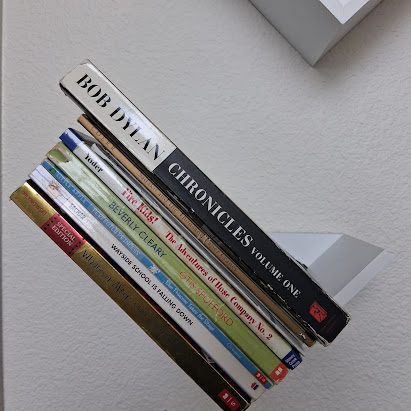
CHRONICLES, VOLUME ONE BY BOB DYLAN

CHRONICLES, VOLUME ONE BY BOB DYLAN

CHRONICLES VOLUME ONE

by BOB DYLAN ( Robert Allen Zimmerman )

kränək(ə)l

Notes from book:

"John Hammond, who had brought me to the Columbia Records, had taken me over to see Lou Levy, asked him to look after me. but he had a premonition that there would be more." Page 4

"It was years before the Beatles, the Who or the Rolling Stones would breathe new life and excitement into it." page 6

"In American history class, we were taught that commies couldn't destroy American with guns or bombs alone, that they would have to destroy the Constitution -the document that this country was founded upon." page 30

“It was said that world war two spelled the end of Age of Enlightenment, but I wouldn't have known it. I was stillin in it. Somehow, I could still remember and feel the right of something about it.I'd read that stuff. Voltaire, Rousseau, John Locke, Montesquieu, Martin Luther-visionaries, revolutionaries... It was like I know those guys, like they'd been living in my backyard.” Page 30

"If you told the truth, that was all well and good and if you told the un-truth, well, that's still well, and good. Folk songs had taught me that." page35

“Some early archaic period where society grows and develops and thrives, then some classical period where the society reaches its maturation point and then a slacking off period where decadence makes things fall apart. I had no idea which one of these Stages Americawes in.” page 36

" ...Those were my favorites[book], but that was before I discovered the folksingers. The folksingers could sing songs like an entire book, but only in a few verses. It's hard to describe what makes a character or an event folk song worthy. It probably has something to do with a character being fair and honest and open. Bravery in an abstract way." page39

“what was the future? The future was a solid wall, not promising, not threatening - all bunk. No guarantees of anything, not even the guarantee that life isn't one big Joke.” Page 49

" I can't say when it occurred to me to write my own songs...I was singing to define the way I felt about the world.

…I guess it happens to you by degrees." page 51

"Protest songs are difficult to write without making them come off as preachy and one- dimensional. You have to show people inside of themselves that they don't know is there." page 54

"...Folk songs are eva-the truth about life, and life is more or less a lie, but hen again that's exactly the way we want it to be. We wouldn't be comfortable with it any other way. A folk song as over a thousand faces and you must meet them all if you want to play this stuff. A folk son song might vary in meaning d it might not appear the same from one moment to the xt. It depends on who's playing and who's listening." page 71

" Chloe knew that I was trying to get places." Maybe someday your name will get around the country like wildfire," She'd say." Page 103

“The future was nothing to worry about. It was awfully close.” Page 104

“Being born and raised in America, the country of freedom and independence, I had always cherished the values and ideas of equality and liberty. I was determined to raise my children with those ideas.” page 115

"Musicians have always know that my songs were about more than just words but most people annave not musicians." page 119

" The first thing that has to go is any form of artistic self-expression that's dear to you. Art is unimportant next to life, and you have no choice. I had no hunger for it anymore, anyway." page 121

"Even the russian newspaper pravda had called me a money hungry capitalist." page 133

"I'm in the bottomless pit of cultural oblivion. You name it. I can't shake it. Stepping out of the woods, people see me coming. I knew what they were thinking. I have to take things for what they were worth." Page 148

for example, ... "The entire song came to me all at once; I don't know what could have brought it on.Maybe seeing the homeless guy, the dog, the cops, ..." page 167

“I started and completed the song "Dignity" the same day. I'd heard the sad news about pistol petty. (Peter Press Maravich, nicknamed "Pistol Pete").page 169

“In New orleans you could almost See other dimensions.” Page 181

"New orleans had the best radio stations in the world." page 188


"Human dynamics plays too big a part, and getting what you want isn't always the most important thing in life anyway." page 218

"folk music was all I needed to exist." page 236

“Pankake was right. Elliott ( Ramblin’ Jack Elliott) was far beyond me.” page 251

Ramblin’ Jack Elliott ( Pankake said sometimes earlier, like Jack being the king of the folksingers... page 252)

“The "Queen of the folksingers, " that would have to be Joan Baez.” page 254

“It was a strange world ahead that would unfold, a thunderhead of the world with jagging lightning adges. Many got it wrong and never did get it right. I went straight into it. It was wide open. One thing for sure, not only was it not run by God, but it wasn't run by the devil either.” page 293


Jim Reves - Eddy Arnold - Gorgeous George - David Amramو Ted Joans- Fred Hellerman - Bobby Neuwirth- Judy Garland - Izzy Young , the owner of folklore center - Johnny Rivers - woody Guthrie - Logan English- Harry Belafonte - Mike porco - Cisco Houston - Paul Clayton - ( Ray Gooch and his partner, Chloe Kiel that help Dylan at first) - Hank Williams, the legendary American country singer and songwriter) - Sun Pie - Joan Baez -

Jon Pankake: A Grammy-winning folk scholar and early critic of Bob Dylan

Woody Guthrie, the legendary American folk musician who was a major influence on Dylan

THE UNWOMANLY FACE OF WAR AN ORAL HISTORY OF WOMEN IN WORLD WAR II by SVETLANA ALEXIEVICH   by SVETL

THE UNWOMANLY FACE OF WAR AN ORAL HISTORY OF WOMEN IN WORLD WAR II by SVETLANA ALEXIEVICH

THE UNWOMANLY FACE OF WAR

AN ORAL HISTORY OF WOMEN IN WORLD WAR II

by SVETLANA ALEXIEVICH

Translated by Richard Pevear and Larissa Volokhonsky

I would like to introduce one of the most influential books written on the discourse of war: 'War Has No Female Face' by Svetlana Alexievich, the Nobel Prize winner in Literature in 2015. The Nobel Academy praised Alexievich's narrative style, hailing the Belarusian author for presenting a fresh genre of documentary literature that portrays the suffering and courage of people, especially women, during World War II. We've often come across a sentence on the internet: 'There are two groups of people who will never lead a normal life again: those who have gone to war and those who have fallen in love.' The exact speaker of this sentence is unclear; some attribute it to Paulo Coelho, the author of 'The Alchemist,' others to Nicholas Sparks, the author of 'Message in a Bottle,' and even to Erich Maria Remarque, the renowned German author best known for 'All Quiet on the Western Front.' But more important than the speaker is the truth hidden within it: soldiers returning from war never return to normal life, and this book narrates this very truth. This book demonstrates that war, contrary to the common perception of it being a solely masculine endeavor, also has a female face. Women served as simple soldiers, snipers, pilots, nurses, doctors, laundry workers, and in dozens of other roles mentioned in this book, both on the front lines and behind them, affected by war and its subsequent consequences. What makes reading this book fascinating is its offering of a different perspective on war—not from the viewpoint of a seasoned general or a veteran politician, but from the perspective of ordinary women who have experienced war up close. This book includes over two hundred poignant accounts of women who fought for the former Soviet Union during WWII, depicting the brutality of war. I will focus on translating and sharing two narratives: " ... I changed so much during the war that when I came home, Mama didn't recognize me. People showed me where she lived. I went to the door and knocked. There come and answer: Yes, come in... " I go in, greet her, and say: Let me stay the night." Mama was lighting the stove, and my two little brothers were sitting on the floor on a pile off straw, naked. They had no clothes. Mama didn't recognize me and said: Do you see how we live? citizen? Go somewhere else before It gets dark." I do up closer, and she again says: "Go Somewhere else, citizen, before it gets dark. I bend over her, embrace her, and murmur mama, dear mam!" Then they all just fell on me and burst out crying..." page 33- 34 and "When the war ended, I had three wishes: first- to ride on a bus, instead of crawling on my stomach; second- to buy and eat a whole loaf of white bread; and third- to sleep in white sheets and have them make crinkly noises. White sheets... " page 39

Notes from book:

The first title of the book started with an uncompleted sentence " I DON'T WANT TO REMOVER..."

"How does a human being remain alone with the insane thought that he or she might kill another human being? Is even obliged to? And I would discover that in war there is, apart from death, a multitude of other things; There is everything that is in our ordinary life. War is also life." page 3

"We came to the recruiting office; We went in one door at once and we let out another. I had such a beautiful braid, and I came out without it... Without braid... they give me a soldier's haircut..." Page 7

"Mama would catch me, press me to her, and talk to me: "Wake up, wake up. The war is over. You're home." I would come to my sense at her words. "I'am your moma. Mama..." She spoke softly. Softly... Loud talk frightened me..." page 11

"He asks: "How many Germans did you kill?" I says to him: " Seventy-five."he says a bit mockingly: "Come on, you probably didn't lay eyes on the single one." page 15

"Can they make a color film about war?Everything was black.Only the blood was another color, the blood was red..." Page 16

"Even if you( soldier) come home alive, your soul will hurt. Now I think: it would be better to be wounded in an arm or a leg. Then my body would hurt, not my soul... It's very painful. We were so young when we went to the front. Young girls. I even grew during the war. Mama measured me at the home... I grew four inches..." page 17

"An instant chemical reaction took place: pathos dissolved in the living tissue of human destinies; It turned out to be a very short-lived substance. Destiny-is where is something else beyond the words." page 19

"What happened to a human being? What did human beings see and understand there? About life-and-death in general? About themselves, finally? I am writing a story of feelings... A story of the soul... Not the history of war or a state and not the lives of heroes, but the history of small human beings, thrown out for ordinary life into the epic depths of an enormous event. Into great history.The girls of 1941... the first thing I want to ask: Where did their kind of from? Why were there so many,? How is it they decided to take up arms on a par with men? To shoot, mine, blow up, bomb- kill." page 19

" ... I changed so much during the war that when I came home, Mama didn't recognize me. People showed me where she lived. I went to the door and knocked.

There come and answer: Yes, come in... "

I go in, greet her, and say: Let me stay the night."

Mama was lighting the stove, and my two little brothers were sitting on the floor on a pile off straw, naked. They had no clothes. Mama didn't recognize me and said: Do you see how we live? citizen? Go somewhere else before It gets dark."

I do up closer, and she again says: "Go Somewhere else, citizen, before it gets dark.

I bend over her, embrace her, and murmur mama, dear mam!"

Then they all just fell on me and burst out crying..." page 33- 34

"Now I live in Crimea... Here. Everything drowns in flower, and every day I look out of the window at the sea, but I am worn out with pain. I still don't have a woman face. I cry often, I moan all day. It's my memories..." page 34

"She deserves to be decoration." Page 35

"When the war ended, I had three wishes: first- to ride on a bus, instead of crawling on my stomach; second- to buy and eat a whole loaf of white bread; and third- to sleep in white sheets and have them make crinkly noises. White sheets... " page 39

"We no longer wept, because in order to weep you also need strength, but we wanted to sleep. To sleep and sleep." page 41

" Everything was black , only the bones were white...and the bone ash... I already recognized it... White as could be..." Page 43

"You think I'll say the most frightening thing in the war is death. To die.

... for me the most terrible thing in the war was - wearing men's underpants. that was fighting." page 65

"we all see life through our occupations , through our place in life or the events we participate in. It could be supposed that a nurse saw one war, a baker another, a paratrooper a third, a pilot a fourth the commander of a submachine-gun platoon a fifth... Each of these women had her own radius of visibility, so to speak." page 72

"I understood Long ago that we are a people of roads and conversation." Page 72

"War is a man's business." Page 74

" Irealize that here the war hasn't ended and never will." page 77

"I was struck each time by this mistrust of what is simple and human, by The wish to replace life with an Ideal. Ordinary warmth with a cold luster. And I couldn't forget how we drank tea The family way in the kitchen And how we both wept." page 89

"We hasn't to forget , to wipe away the traces, because preserved facts can become evidence, often at the cost of life. No one knows anything further future back than their grandparents; no one looks for their roots. They made history, but live for the day. On short memory." page 91

"And Would you like to forget the wall? ..."And I'd like to forget. I want to ... " Olga Vasilyevne utters slowly, almost in a whisper. "I want to live at least one day without the war. Without our memory of it... At least one day..." page 98

"when things live in the house for a long time they acquire a Soul. I believe that." page 99

"... You can't shoot unless you hate. It's war, not a hunt." page 105


"When I Put on a dress for the first time, I flooded myself with tear. I didn't recognize myself in the mirror .we had spent four years in trousers.

...men didn't shave the victory with us. It was painful... Incomprehensible... Because at the frontmentreated us marvelously well; They always protected us." page 109

"I can't say anything to you, Valya, I can only weep, " but there's no need to pity us. We're proud. Let them rewrite history ten times. witt Stalin or without Stalin. But this remains - We were victorious! And our sufferings. What we lived through. This isn't Juck or ashes. This is our life. Not a word more...." page 112

" ... It's terrible to remember, but it's far more terrible not to remember."

Now I understand why they speak all the same..." Page 112

"Whenever I see wild flower, I remember the war. We didn't pick flowers then. And if we made bouquets, it was only when the buried someone... when we bid farewell." page 129

"I forgot everything in the war. My former life. Everything...and I forget love..." Page 137

"A human face is molded over a long time. The soul is slowly traced on ithuman face is molded over along time. The soul is slowly traced on it. But the war quickly created its image of people. Painted its own portraits." Page 150

"And you are all fine girls, no cowards. The war is over you could go back home, but you go to defend your motherland." Page 175.

"We're volunteers! We come to defend the motherland. we'll onlygotothe combat units..." page 181

"And no one told us again that we were beautiful. But beautiful girls were pitied at the war, more pitied. That's true. It was a pity to bury them ... A pity to send the death notice to their mamas..." page 182

" They needed soldiers... But we also wanted to be beautiful..." page 187

"Your strongest medicine is love. love protects, it gives the strength to survive." Page 187

"There was a belief, probably from the earliest times, that cats and women bring bad luck to sea." page 202

"And now there will be a story about love...

love is the only personal event in wartime. all the rest is common-even death." page 226

" I left Kazan for the front as a nineteen years old girl... Six months later I wrote my mother that people thought I was twenty-five or twenty- seven. Every day is spent in fear and terror." page 239

" When a man dies he always looks up, never to the side or at you, if you're next to him. only up... At the ceiling... But If he's looking into the sky..." page 239

""""" But it was impossible to think of anything personally when the motherland was in danger.""""" page 241

""""" I always proud that I had been at the front. Dfending the Motherland. """"" page 246

""""" I loved the motherland more than anything in the world. """"" page 250

""""" we crossed the border- the Motherland was free. our land... """"" page 303

"In our villages on Victoria day there is weeping, not rejoicing. Many weep. They grieve. " It was horrible... I buried all my family, I buried my soul in the war" ( V.G. Androsik, underground fighter). They. begin to talk softly, and in the end almost all of them shout." page 251

" My little son! we prepared the house for you! You promised you would bring kma young wife home! But you are marrying at the earth..." page 287

"To this day, I speak in a whisper ... about ... that ... In a whisper. After more than forty years... I've forgotten The war... Because even after the war I lived in fear, I live in hell." Page 298

"At the front, I couldn't imagine ever being able to read Heine's poems again. My beloved Goethe. I could never again listen to Wagner... Before the war, I grew up in a family of musicians, I love German music - Bach, Beetthoven. The great Bach! I crossed all of this out of my world." page 308

"We need hundreds like you, my girl, to tell our story. To describe all our sufferings. Our countless tears. My dear girl... "page 322

" For a long time after the war, I was afraid of the sky, even of raising my head toward the sky. I was afraid of seeing plowed-up earth. But the rooks already walked calmly over it. The birds quickly forgot the war." page 331


https://www.youtube.com/watch?v=oN32AbDqMkg&t=140s

https://adelesmaeilpour.wordpress.com/2025/05/08/the-unwomanly-face-of-war-an-oral-history-of-women-in-world-war-ii-by-svetlana-alexievich/